
A/B testing has been the gold standard of conversion rate optimisation for the better part of two decades. The methodology is clean: show half your visitors version A, the other half version B, wait for statistical significance, implement the winner, repeat. It works in principle. And it still works in certain conditions.
But we are seeing it fail more businesses more often than it used to. As a result, many businesses are looking for alternatives to A/B testing for CRO that deliver faster, more practical insights without requiring massive traffic volumes.
Why A/B Testing Is Losing Effectiveness
The traffic volumes are not there anymore. Valid A/B testing requires sufficient sample sizes to reach statistical significance within a reasonable timeframe. With CPCs rising across Australian markets, as covered in our article on rising CPC trends, and AI Overviews reducing organic click-through rates, many landing pages are receiving less traffic than they did two years ago.
Testing one variable at a time does not reflect how conversion actually works. A visitor’s decision to convert is the product of dozens of signals interacting simultaneously. Optimising one variable in isolation produces findings that frequently do not replicate in real conditions.
Personalisation has fractured the average visitor assumption. A version that wins on aggregate may be actively losing with your most valuable audience segments. Dynamic content approaches, covered in our article on dynamic landing pages and AI personalisation, address this more effectively.
Alternatives to A/B Testing for CRO
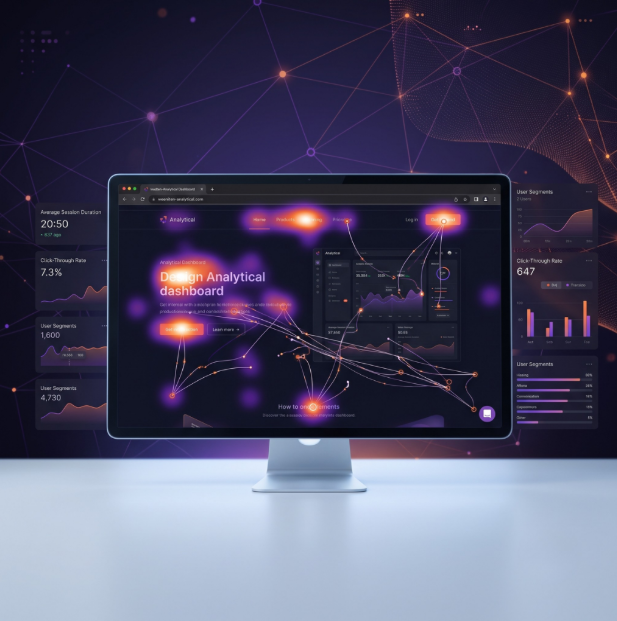
Behaviour-led optimisation is emerging as one of the most effective alternatives to A/B testing for CRO. Rather than waiting weeks or months for statistical significance, it focuses on identifying real user friction through session recordings, heatmaps, funnel analysis and qualitative feedback. This approach allows businesses with lower traffic volumes to improve conversion rates based on observed behaviour instead of hypotheses.
What Behaviour-Led Optimisation Actually Looks Like
Behaviour-led optimisation uses direct observation of how real users interact with your pages to identify friction, rather than running probabilistic experiments.
Session recordings (Hotjar, Microsoft Clarity, and Clarity is free). Watching real user sessions reveals things that no quantitative metric will surface. Five session recordings of visitors who did not convert are often more instructive than a month of A/B test data.
Heatmaps. Aggregate click and scroll maps show immediately whether users are reaching your key content and whether your primary CTA is in a dead zone.
Funnel drop-off analysis. If 65% of users are abandoning a multi-step form at step two, that page needs a direct UX review, not an A/B test. Our website design service addresses structural UX issues at the build level.
Exit intent surveys. A single question answered by even 20 users provides qualitative insight that statistical testing cannot produce.
The Workflow That’s Replacing A/B Testing
- Use session recordings and heatmaps to identify the top three friction points on the page
- Fix those specific issues based on observed user behaviour, not hypothesis
- Measure before-and-after conversion rate over 30 days
- Identify the next friction point and repeat
For the structural changes that most commonly surface as friction points during behaviour-led reviews, see our articles on why traditional landing pages fail in AI search and how patients interact with landing pages before booking.
If you are looking for practical alternatives to A/B testing for CRO, behaviour-led optimisation provides a faster and more actionable framework for improving conversion rates. Our conversion rate optimisation service can help implement this approach without relying solely on long-running experiments.
Frequently Asked Questions
What is behaviour-led optimisation?
Behaviour-led optimisation is a CRO methodology that uses direct observation of how real users interact with a page to identify and fix conversion friction. It relies on session recordings, heatmaps, funnel drop-off analysis, and exit intent surveys. Our conversion rate optimisation service uses this approach as standard.
What tools are used for behaviour-led CRO?
The most commonly used tools are session recording platforms (Hotjar, Microsoft Clarity, which has a free tier), heatmap tools, funnel analysis tools within Google Analytics 4, and exit intent survey tools. These tools integrate with most website design platforms.
When does A/B testing still make sense?
A/B testing remains valuable when you have high enough traffic volumes to reach statistical significance within a reasonable timeframe, and when you are genuinely uncertain which of two directions will perform better. For higher-traffic pages where conversion rate is a strategic priority, it remains a useful tool.
What are the best alternatives to A/B testing for CRO?
Behaviour-led optimisation is one of the strongest alternatives to A/B testing for CRO, particularly for businesses that do not generate enough traffic for statistically significant experiments. Techniques such as session recordings, heatmaps, funnel analysis and exit intent surveys can uncover conversion issues much faster than traditional A/B testing.
How long does behaviour-led CRO take to show results?
Meaningful improvements can often be measured within 30 days. Businesses that move from minimal CRO activity to a structured behaviour-led process typically see conversion rate improvements within the first one to two cycles. Our landing page optimisation service applies this methodology as part of ongoing engagement.