
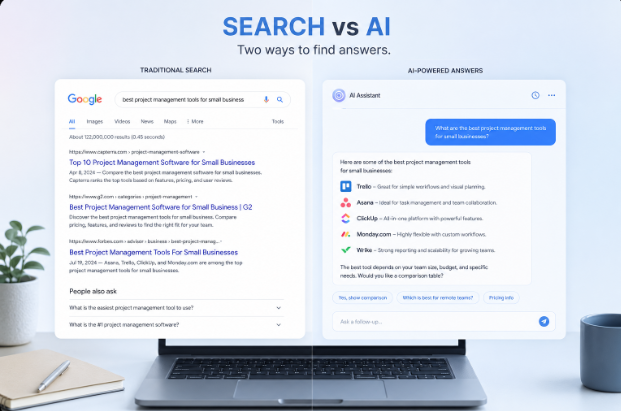
For most of the past decade, SEO meant one thing: get your pages ranking on Google. That is still true, but it is no longer the whole picture.
When a business owner in Brisbane asks ChatGPT “what’s the best social media agency in Australia”, they are not opening Google. When a marketing manager in Sydney asks Perplexity “how much does SEO cost”, the answer arrives in a chat window, not a list of blue links. That is the shift.
Answer Engine Optimisation, or AEO, is the practice of structuring your content so AI tools cite you as the source when they generate those answers.
This article covers the strategic layer. For the technical implementation, including schema markup and entity signals, see our guide on entity SEO for Australian websites.
What Is AEO?
AEO is not a replacement for SEO. Think of it as the next layer on top of it.
Traditional SEO gets you ranking for a keyword. AEO gets you cited in the AI-generated answer that now sits above many of those rankings. The same principles apply, including quality content, topical authority, and technical foundations, but AEO adds specific structural requirements that make your content easier for AI systems to extract, trust, and reference.
When we audit client sites through our SEO services, the gap between pages that AI systems cite and pages they ignore usually comes down to three things: answer clarity, structural formatting, and demonstrable authority signals.
The Crucial AEO vs SEO Difference
Traditional SEO optimises for crawlers and ranking algorithms. AEO optimises for how large language models process, extract, and attribute information.
Structure over density. AI systems prefer a direct answer in the first two sentences, not a keyword-heavy paragraph.
Specificity over breadth. A page that thoroughly answers one narrow question outperforms a page that superficially covers ten.
Citations and authority. AI tools draw from sources that other credible sources reference. External mentions and backlink profiles matter.
Schema and entity markup. Structured data helps AI systems understand what your content is, not just what words it contains. For a deep dive into this, see our article on entity SEO and Google’s Knowledge Graph.
Why This Matters for Australian Businesses in 2026
The adoption of AI search tools in Australia has accelerated well beyond what most businesses anticipated two years ago. Queries that previously drove organic traffic are being answered before a click ever happens.
If your business is not being cited in those answers, you are invisible to an increasingly large segment of your audience. The CTR impact is already measurable, as we covered the data in our article on how Google AI Overviews are killing click-through rates.
What to Prioritise
Answer questions directly. Start each major section with a clear, specific answer. Two to three sentences, then expand.
Build depth across a topic cluster. A single well-optimised page is less authoritative to an AI system than a collection of interconnected pages demonstrating genuine expertise. This is exactly what our content marketing service is built around.
Earn external citations. Being mentioned in Mumbrella, Smart Company, or industry directories is how AI systems validate that your business is a legitimate authority.
Implement structured data. FAQ schema, HowTo schema, and Organisation schema make your content more parseable by AI systems.
The window to establish early authority in AI search is still open, but not indefinitely. If you are unsure where to start, our free marketing audit can identify your current AI visibility gaps.
Frequently Asked Questions
What is Answer Engine Optimisation (AEO)?
Answer Engine Optimisation is the practice of structuring content so that AI-powered search tools, including ChatGPT, Google Gemini, Perplexity, and Google AI Overviews, cite your content as a source when generating answers to user queries. It builds on traditional SEO foundations but adds specific requirements around answer clarity, structural formatting, and demonstrable authority signals.
Is AEO replacing SEO?
No. AEO is an extension of SEO, not a replacement. Traditional SEO practices including keyword targeting, technical site health, and link building remain relevant. AEO adds a layer of optimisation focused on how AI systems extract and attribute content.
How do I know if my content is AEO-ready?
An AEO-ready page typically opens each major section with a direct, specific answer in the first two to three sentences. It uses question-format headings, has a clear FAQ section, implements relevant structured data, and is supported by external citations from credible sources. A practical way to check your current position is to run through our AI visibility audit steps.
Which AI tools should I be optimising for?
The primary platforms Australian businesses should consider are Google AI Overviews, ChatGPT, Google Gemini, and Perplexity. The content signals that improve visibility across all of them are broadly consistent: clear direct answers, strong structural formatting, authoritative external citations, and consistent entity signals across your website.