
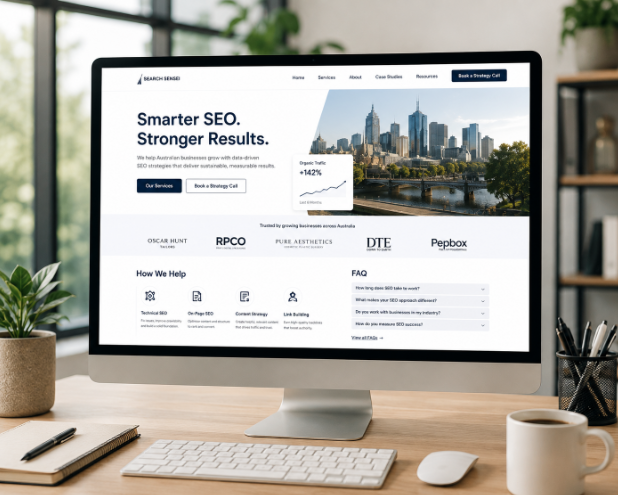
Landing pages have always had one job: convert the person who lands on them. That is still the job. But in 2026 there is a second audience you need to think about: Google’s AI, which is crawling your pages and deciding whether your content is worth citing in an AI Overview.
Where our article on how Google AI Overviews are reducing click-through rates covered the traffic strategy level, this article covers the page-level structural changes that help your landing pages get cited.
Why Landing Pages Appear in AI Overviews
Google does not restrict AI Overview citations to blog posts or informational articles. Service landing pages get cited too, when they contain specific, clearly structured content that answers questions users are asking.
We have seen client landing pages appear in AI Overviews for service-level queries without any deliberate effort to target AI search. The pages happened to be well-structured, answer-led, and technically clean.
Structural Changes That Help AI Extraction
Answer the primary question your page addresses in the opening section. Do not save the substance for after the hero section. AI cannot extract what is buried below a full-width image and a three-word tagline.
Write your key section headings as questions. H2s and H3s formatted as questions mirror the natural language queries users type into AI search tools. This is also the format our SEO service uses when writing service pages for clients.
Add a FAQ section with schema markup. FAQs serve both purposes simultaneously: they address pre-purchase questions that help visitors convert, and they provide the clean Q&A structure that AI Overviews extract directly.
Make factual claims specific and verifiable. Specificity builds citation preference.
Technical Optimisation for AI Search
Structured data beyond FAQs. Service schema on your landing pages tells Google’s systems explicitly what service you offer, who it is for, and where you operate. For a full entity-level view of why this matters, see our article on entity SEO and Google’s Knowledge Graph.
Core Web Vitals and crawlability. Pages with slow load times or content buried inside JavaScript layers are less reliably crawled and extracted by AI systems.
The Conversion Test
Before implementing any change for AI visibility, run this check: does this make the page clearer and more useful for a real visitor? If yes, implement it. If a change serves AI extraction but would confuse a human visitor, it is the wrong change.
For the counterpart to this article, covering what happens when traditional landing pages get this wrong, see why traditional landing pages fail in AI search. For the behaviour-led approach to optimising existing pages, see our article on why A/B testing is dying.
If you want to improve your landing page optimisation while protecting the conversion performance your paid campaigns depend on, that is a discipline that requires both SEO and CRO thinking working together.
Frequently Asked Questions
Can a service landing page appear in Google AI Overviews?
Yes. Service landing pages can and do appear in AI Overviews when they contain clearly structured, specific content that directly answers questions users are searching for. If you want to check whether your current pages are structured for AI extraction, our SEO team can run a page-level audit.
What structured data should I add to a landing page for AI search?
The highest-priority structured data types are FAQ schema, Service schema, and breadcrumb schema. Organisation schema on your homepage supports entity recognition across your entire site. For a full explanation of how these work together, see our article on entity SEO.
Does optimising for AI Overviews hurt conversion rate?
In most cases, no. For a framework on testing this without sacrificing performance, see our article on behaviour-led CRO.
What is Core Web Vitals and why does it matter for AI search?
Core Web Vitals is Google’s set of page experience metrics measuring loading speed, interactivity, and visual stability. Pages that perform poorly are less reliably crawled and indexed. For support with technical page performance, our website design and development service can address underlying speed and structure issues.